

Retail runs on small margins and fast decisions. A single store owner is tracking walk-in customers and online orders at the same time, chasing stock that's running low in one location while it gathers dust in another, and trying to turn a one-time buyer into someone who comes back next month. Add a second branch or a webshop and the spreadsheets stop coping. Bitrix24 — the platform we implement as an authorised partner — markets its retail edition around exactly that reality, pulling sales, marketing, inventory and customer history into a single workspace. Bitrix24 sums up its retail pitch in three words on its own product page: "Powerful. Scalable. Built to sell." Here's what's actually in it, sourced from Bitrix24's own pages.
One CRM for orders, customers and repeat sales
Bitrix24 positions its retail solution as a unified platform for stores and eCommerce, whether you sell handmade jewellery or household appliances. Leads and orders, communications and customer history all sit in one CRM, so a team can see every interaction with a shopper — in-store, on the phone, or online — instead of piecing it together from separate tools. Bitrix24's retail page frames the goal plainly: turn one-time buyers into loyal customers with timely offers and reminders, and target customer groups with relevant, high-impact offers rather than blasting everyone the same message.
Because the CRM is the same engine Bitrix24 runs across every industry, the retail-specific value is in how it's set up: which order statuses match your fulfilment process, which customer segments matter for a fashion boutique versus an electronics shop, and which fields you actually need on a deal.
Omnichannel marketing that brings buyers back
Repeat business is where retail margins are won, and Bitrix24 builds marketing directly into the CRM. Its retail page describes launching and managing ad campaigns across social media, email and SMS, segmenting audiences, and analysing results to improve ROI — all from the same place the customer data lives. Because campaigns run off CRM segments, an offer can be aimed at, say, customers who bought once and haven't returned, rather than a generic list.
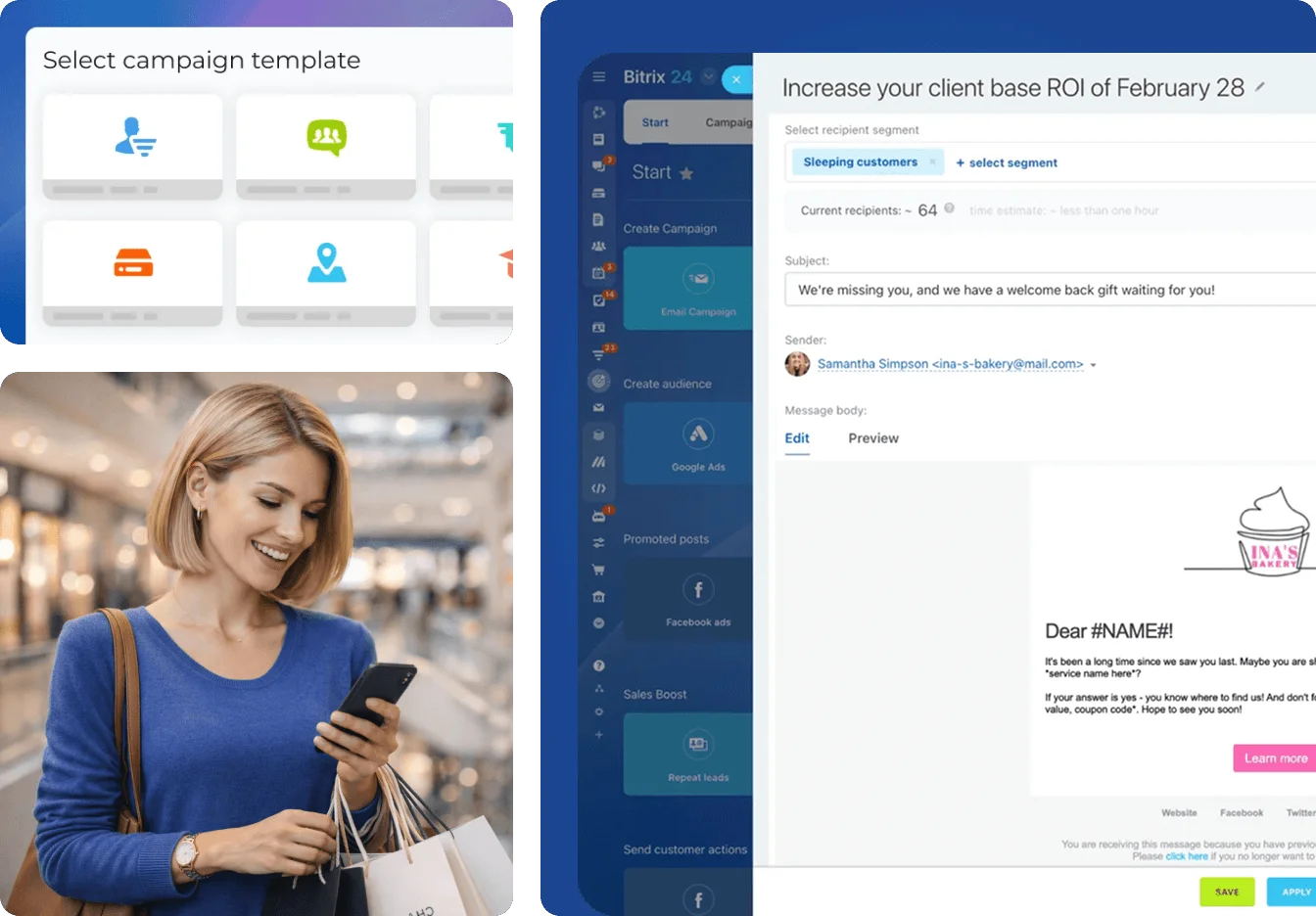
Bitrix24 retail marketing & CRM · © Bitrix24
Bitrix24 also reports collecting insights on campaign performance and buying behaviour, so the store can see which channels and offers actually moved sales and put budget where it works. For a small retailer, that closes the loop between a promotion and a purchase without a separate analytics tool.
Inventory and stock control across every location
Bitrix24's retail solution includes inventory management as one of its core capability areas, letting a business track receipts, sales, transfers and write-offs and manage stock across multiple locations from a single workspace view. That matters most the moment you have more than one place to keep stock: instead of reconciling two spreadsheets, transfers and adjustments are logged against the same system that holds the orders and the customers.
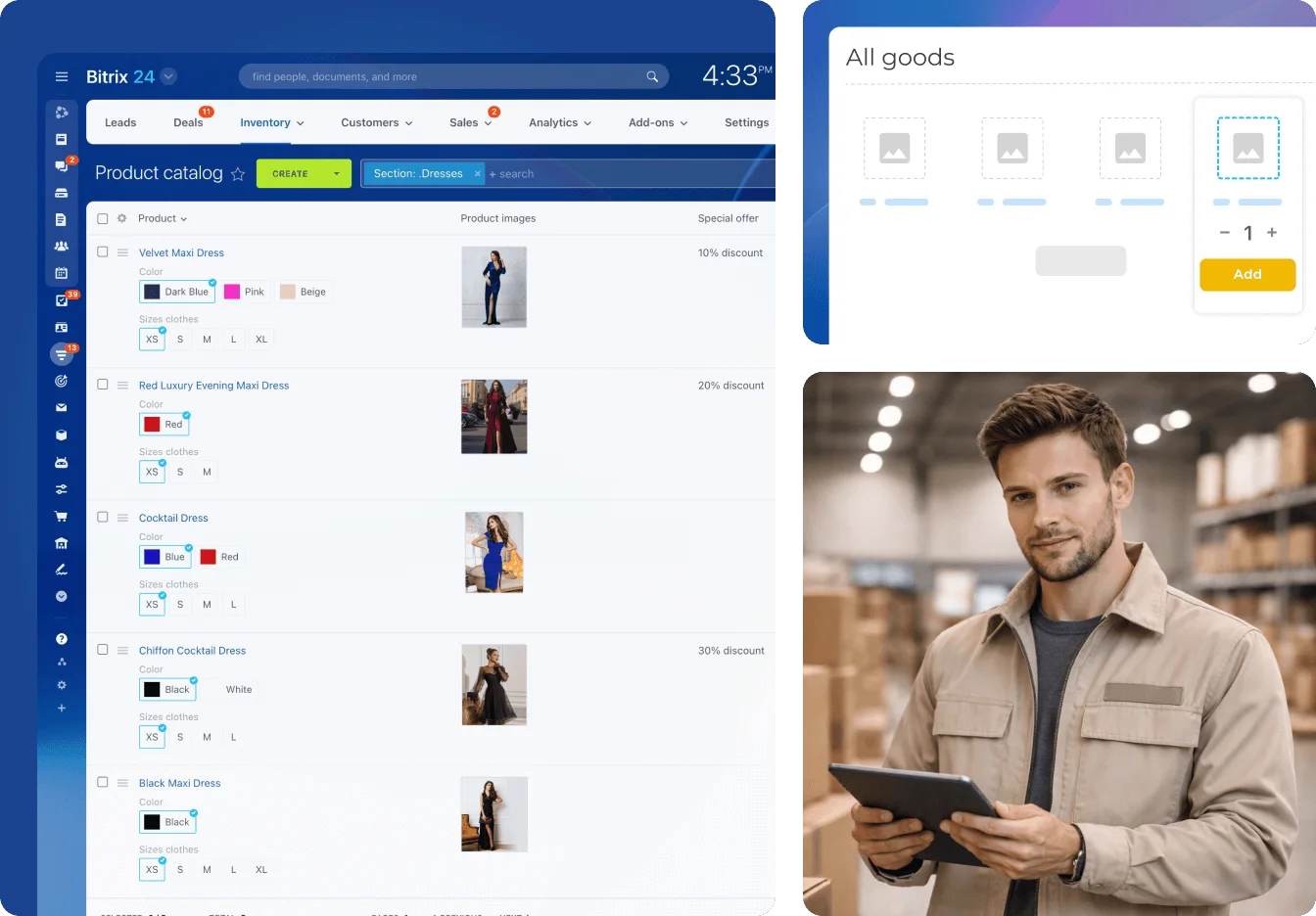
Bitrix24 retail inventory & analytics · © Bitrix24
A built-in online store, payments and 500+ integrations
Retailers rarely sell through one channel any more, and Bitrix24 lists online store management, invoice delivery and payment processing among its retail tools. On the pricing side, its Standard plan explicitly bundles e-commerce, online payments, a website builder and WhatsApp marketing — the pieces a store needs to take orders online and get paid. For anything Bitrix24 doesn't do natively, its retail page points to more than 500 integrations and a REST API covering payment systems, e-commerce platforms, and SMS, chat and call services, plus custom integrations built by partners.
CoPilot AI and an omnichannel Contact Center
Bitrix24's AI assistant, CoPilot, is woven through the CRM. On Bitrix24's own tools page, CoPilot in CRM handles call audio-to-text transcription, call summaries and field autocompletion in deals — which for a busy shop means a phone enquiry can be logged and summarised without someone typing it up by hand. Combined with the Contact Center, which connects channels like phone, email and messaging into one CRM inbox, a small retail team can answer customers wherever they reach out and keep the whole conversation attached to the right record.
"We have been using Bitrix24 for 8 years as an internal communication platform connecting approx. 40 of our branches." — Jörg Geißler and René Ulrich, CEOs, Mobilblitz (Bitrix24 customer testimonial)
What it costs
Per Bitrix24's own pricing page, plans are billed as a flat fee per organisation rather than per user, so adding staff within your plan's user cap doesn't raise the bill. There's a genuinely free plan (100% free for 1–2 users, 5 GB storage, basic CRM and tasks) to test the workflow. Paid tiers, priced per organisation per month on annual billing, run from Basic at US$49 (5 users, website builder and telephony), to Standard at US$99 (50 users, adding e-commerce, online payments and WhatsApp marketing), to Professional at US$199 (100 users, with sales automation and AI throughout). For most single or small multi-store retailers, Standard is the plan that unlocks the online-store and payment features. (Prices verified on Bitrix24's pricing page at the time of writing and may vary by region.)
Where a partner comes in
None of this is exclusive to retail — the same CRM, marketing, inventory and automation engine underpins Bitrix24 across every industry. What changes is the configuration: which order statuses mirror your fulfilment, which customer segments drive your campaigns, how the online store connects to your payment provider, and which integrations tie it all together. That setup work is what we do at B24 Biz Solutions as an authorised Bitrix24 partner based in Dubai, covering the UAE, wider Middle East and South Asia.