
How Bitrix24 Helps Manufacturing Companies Manage Production, Inventory and Clients in One Platform

Bitrix24 positions one workspace across production, stock and customer data · © Bitrix24
A manufacturing business is really several businesses stacked on top of each other. There is a shop floor with shifts, supervisors and daily work reports. There is a store of raw materials and finished goods that has to be counted, moved, transferred and occasionally written off. There is a sales side fielding enquiries from distributors, contractors and export buyers. And there is a finance side that wants to know, at the end of the month, which products and which channels actually made money. In most small and mid-sized manufacturers those four things live in four different places — a messaging group, a spreadsheet, an accounting package and somebody's memory. The gaps between them are where late deliveries, stock surprises and unanswered enquiries come from.
Bitrix24 pitches itself to manufacturers as a single workspace covering that whole span. Its official manufacturing page names four pillars: built-in inventory and materials control, streamlined client and partner communication, shift and workforce coordination, and in-depth operational analytics — and it presents the setup as suitable for discrete, continuous process, repetitive, job-shop and batch manufacturers alike. Below is what those pillars actually contain, taken only from Bitrix24's own published pages.
Keeping shop-floor teams aligned and accountable
The workforce side is built around attendance and reporting rather than abstract HR admin. Bitrix24 lets you track employee clock-in and clock-out across shifts, see check-ins in real time, and collect and manage work reports coming from the shop floor. It can send automatic notifications when shift hours are violated, so a supervisor finds out about an overrun on the day it happens rather than at payroll. There is also a knowledge base you can build up for training new employees — useful in an industry where induction, safety briefings and machine-specific procedures are repeated with every new intake and every contract crew.
For a plant running two or three shifts, the value is less about any single feature and more about the fact that attendance data, work reports and the training material sit in the same account as the orders those shifts are producing against.
Inventory and materials control in the same place as orders
This is the part manufacturers usually care about most, and it is the part most likely to be stranded in a spreadsheet. Bitrix24's inventory management lets you control and update stock for finished goods, record receipts, sales, transfers and write-offs, and track individual product variations along with their associated costs. Multiple warehouses can be managed from a single workspace, and inventory balance reports let you monitor stock levels without exporting anything.
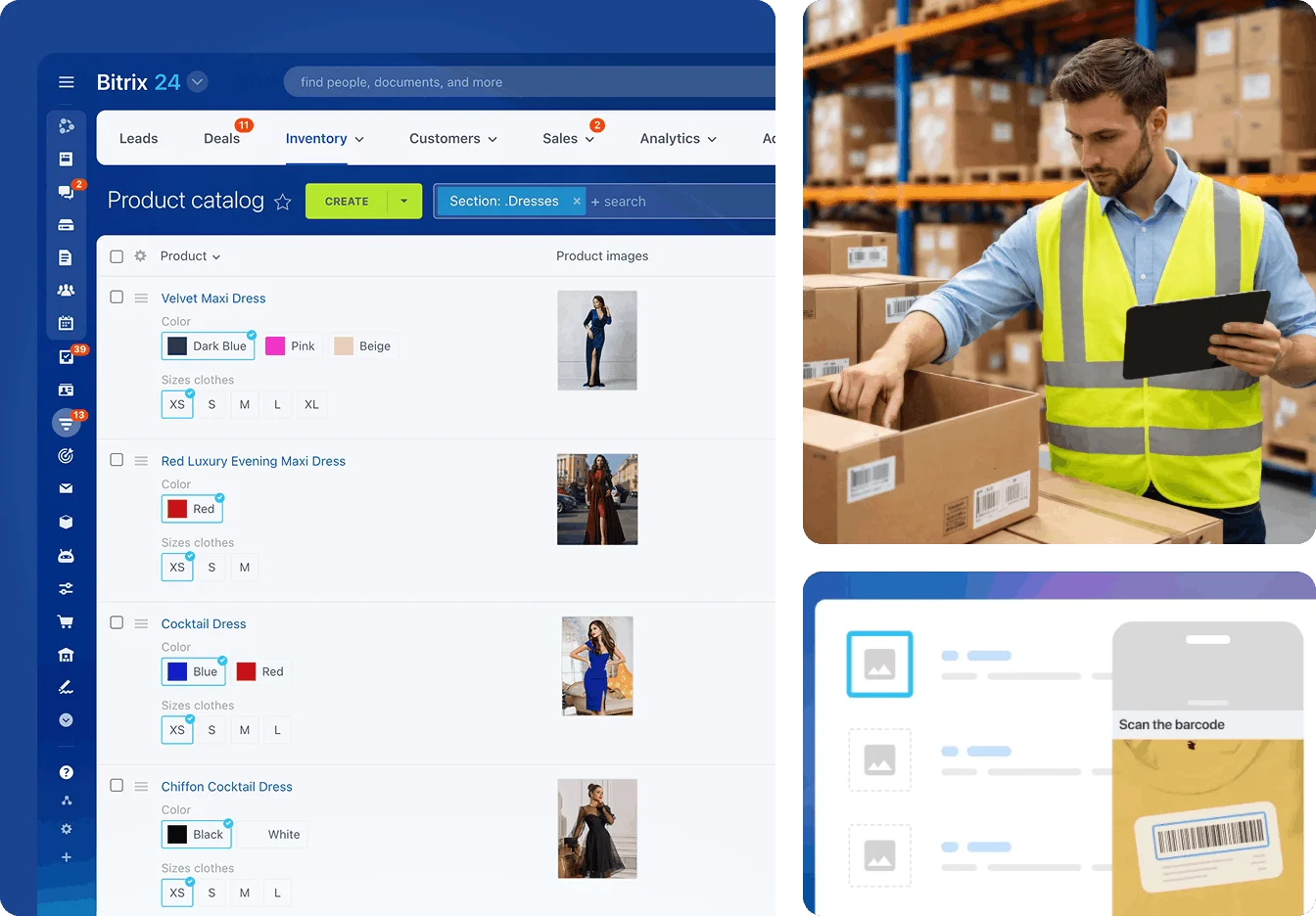
Multi-warehouse stock control with receipts, transfers and write-offs · © Bitrix24
The point that matters operationally is the link back to sales. Bitrix24 describes the aim as connecting "inventory data with customer orders to optimize operations" (Bitrix24). When a deal is confirmed in the CRM, the stock position behind it is not a separate question someone has to go and ask.
Turning enquiries into orders across every channel
Manufacturing enquiries rarely arrive through one door. Bitrix24's contact centre side lets you connect chatbots, messengers and telephony so responses go out quickly, notifies the team instantly when a new customer message arrives, and stores every interaction and the full purchase history in one system. Calls and messages can be answered on the move through the mobile app, and feedback or reviews can be collected through CRM forms.
The website side is part of the same account rather than a bolt-on. You can create and customise a site without coding, update product information and stock levels quickly, collect orders through CRM forms placed on that site, and offer support through chat widgets, web forms and callbacks. For a manufacturer selling to trade buyers, that is often enough to replace a static brochure site that nobody has updated since the last catalogue.
AI and automation for the routine work
Bitrix24's AI-powered tools are aimed squarely at the admin that eats a sales coordinator's day. The platform can automatically fill CRM cards using details taken from phone calls, create tasks from voice messages, and summarise and record meeting outcomes so decisions get written down. Sales scripts and operator performance analysis sit alongside this, as does the ability to analyse how effective a flow is and optimise task management accordingly.
Automation goes further on the higher plans: Bitrix24's pricing page lists workflow automation, task automation, robotic process automation (RPA) and e-signature among the features included from the Professional plan upward.
Analytics that show what actually makes money
The reporting side is framed around decisions rather than dashboards for their own sake. Bitrix24 lets you identify repeat buyers and apply targeted pricing, analyse which marketing sources perform best to improve ROI, track lead performance across all sales stages, and monitor gross profit and inventory level through reports. Site analytics can be connected too, tracking traffic, clicks and engagement.
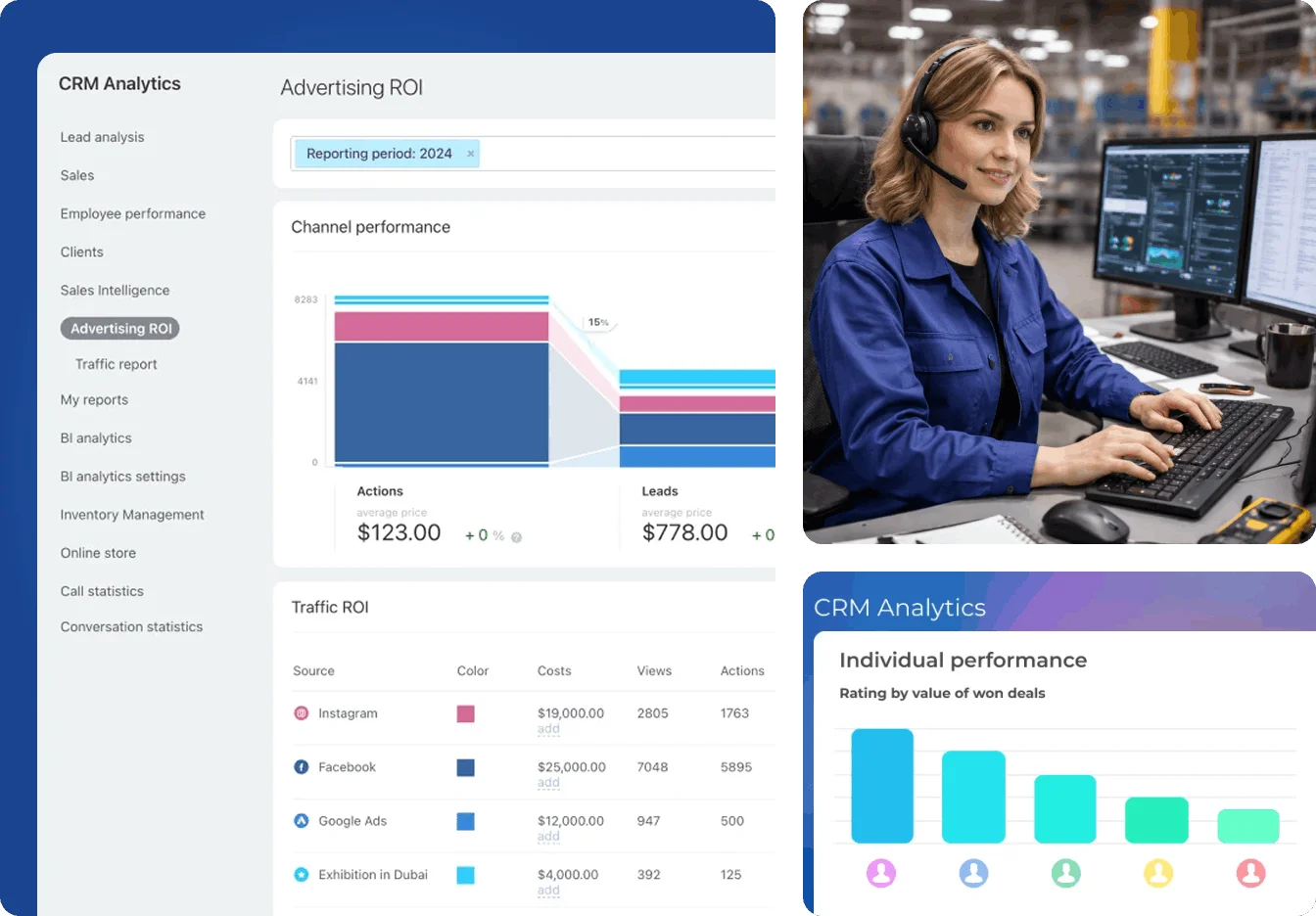
Sales and profitability reporting built on the same data as the CRM · © Bitrix24
Connecting to the systems you already run
Very few manufacturers are going to replace an established ERP or accounting package, and Bitrix24 does not ask them to. Its manufacturing page points to more than 500 integrations plus a REST API, and specifically calls out ERP and accounting systems, payment systems, and SMS, chat and call services — with custom integrations available through Bitrix24 partners where an off-the-shelf connector does not exist.
What it costs
Bitrix24 charges a flat rate per organisation rather than per seat, which is unusual in this category and tends to suit manufacturers with a lot of occasional users. On annual billing, the published plans are: Free for 1–2 users with 5 GB of storage; Basic at US$ 49 per month for 5 users and 24 GB, adding sales pipelines, telephony and the website builder; Standard at US$ 99 per month for 50 users and 100 GB, adding sales automation, invoices and e-commerce; Professional at US$ 199 per month for 100 users and 1 TB, adding workflow automation, RPA, e-signature, analytics tools, HR management and employee hours tracking; and Enterprise at US$ 399 per month for 250 users and 3 TB. Prices are as published on Bitrix24's pricing page at the time of writing and should be confirmed before you budget against them.
Where a partner comes in
Bitrix24 is broad, and breadth is exactly what makes a self-service rollout stall in a factory. Bitrix24's own manufacturing page frames the partner role around four things: quick implementation, employee education so people start faster, picking the right plan, and tailored customisation. In practice the work is deciding which warehouses and product variations to model, how a confirmed deal should move stock, which shift rules should trigger notifications, and where the ERP boundary sits.
B24 Biz Solutions is an official Bitrix24 partner based in Dubai, working with manufacturers and industrial businesses across the UAE, the wider Middle East and South Asia. We configure inventory, shift tracking, CRM pipelines and reporting around how your plant actually runs — and train the people who will use it daily.
Sources
Want this set up for your plant?
We configure Bitrix24 inventory, shift tracking, CRM and reporting for manufacturers across the UAE, Middle East and South Asia.
Book a free consultation →