
How Bitrix24 Helps Laundry, Dry Cleaning and Uniform Services Manage Contract Accounts, Collections and Recurring Billing in One Platform
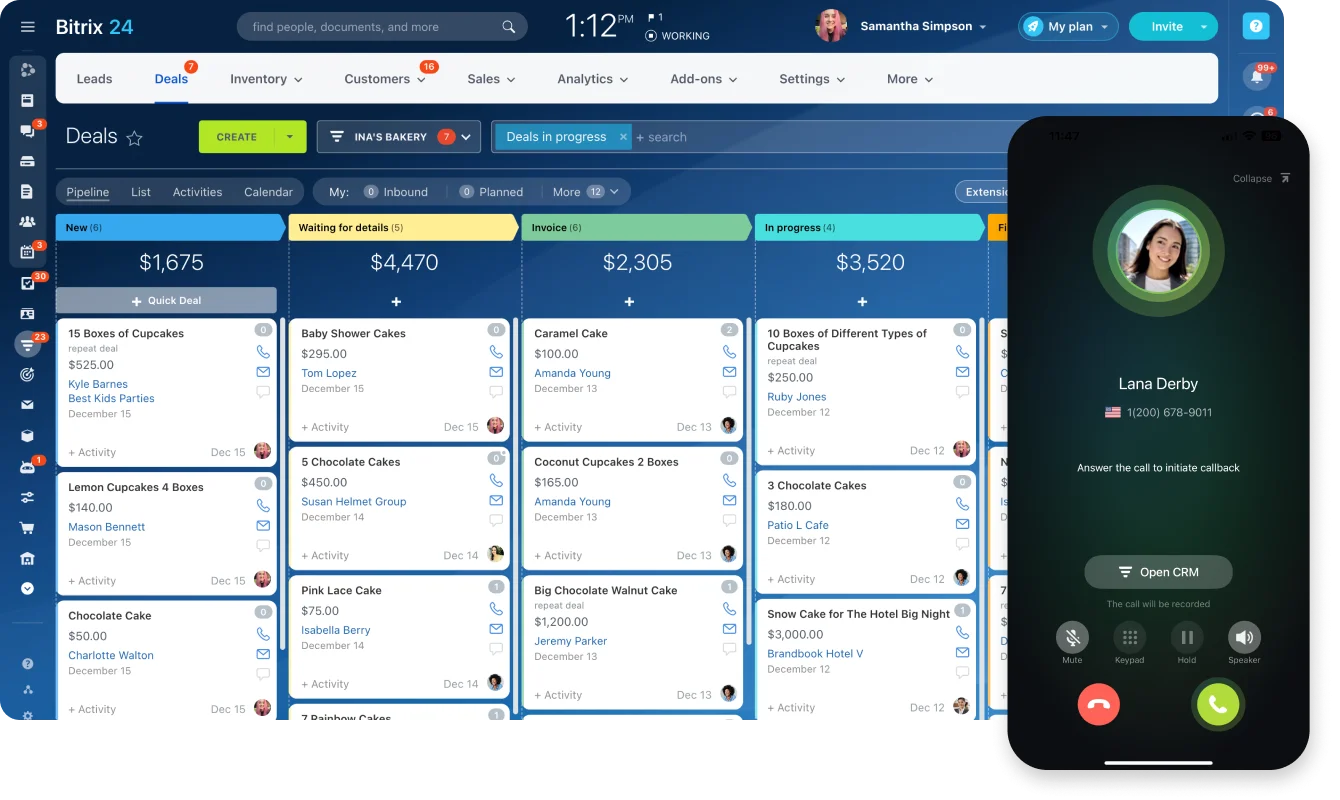
Leads, deals and pipelines in Bitrix24 CRM · © Bitrix24
A laundry business runs on two clocks at once. There is the retail clock — a customer drops a suit on Tuesday, wants it Thursday, and phones on Wednesday to ask if it is ready. And there is the contract clock — a hotel in Deira, a clinic in Jumeirah, a facilities company with four hundred uniforms, each expecting a collection on a fixed day, a delivery on another fixed day, and one invoice at month end that reconciles against a count nobody wrote down properly.
Most operators handle the first clock with a paper docket book and the second with a spreadsheet plus a WhatsApp group. It works until a driver is off sick, a hotel disputes a piece count, or the person who owned the spreadsheet resigns. What follows is a look at what Bitrix24 actually offers a laundry, dry cleaning or uniform services business — every capability taken from Bitrix24's own published pages — and an honest section on what it does not do.
Two pipelines, because you are running two businesses
Bitrix24 CRM is built on leads, deals and pipelines, and Bitrix24 describes the platform as everything you need to acquire leads, turn them into deals, receive payments, manage inventory, e-sign documents, run marketing campaigns and track sales metrics. The important part for a laundry is that a deal is not locked to a generic sales funnel — pipelines carry stages you define.
So a contract pipeline reads something like enquiry, site visit, pricing agreed, trial period, contract signed, active account. And a separate operations pipeline reads collected, sorted, in process, quality check, packed, out for delivery, delivered. A hotel account sits in the first pipeline for months while individual collection cycles run through the second. Keeping them apart is the whole point: a deal waiting on a signature should never share a column with a bag of shirts waiting on a press.
Bitrix24 also lists recurring deals as a plan feature, which is the natural shape of a monthly laundry contract — the account renews on a schedule rather than being retyped every month by whoever remembers.
One inbox for the customer who never uses the same channel twice
Bitrix24's Contact Center is explicitly omnichannel. Bitrix24 states that no matter how a client gets in touch — web form, email, live chat, social media, messenger or telephony — the message is processed in the Contact Center and automatically turned into a lead in the CRM, from which you can continue the conversation or create a deal.
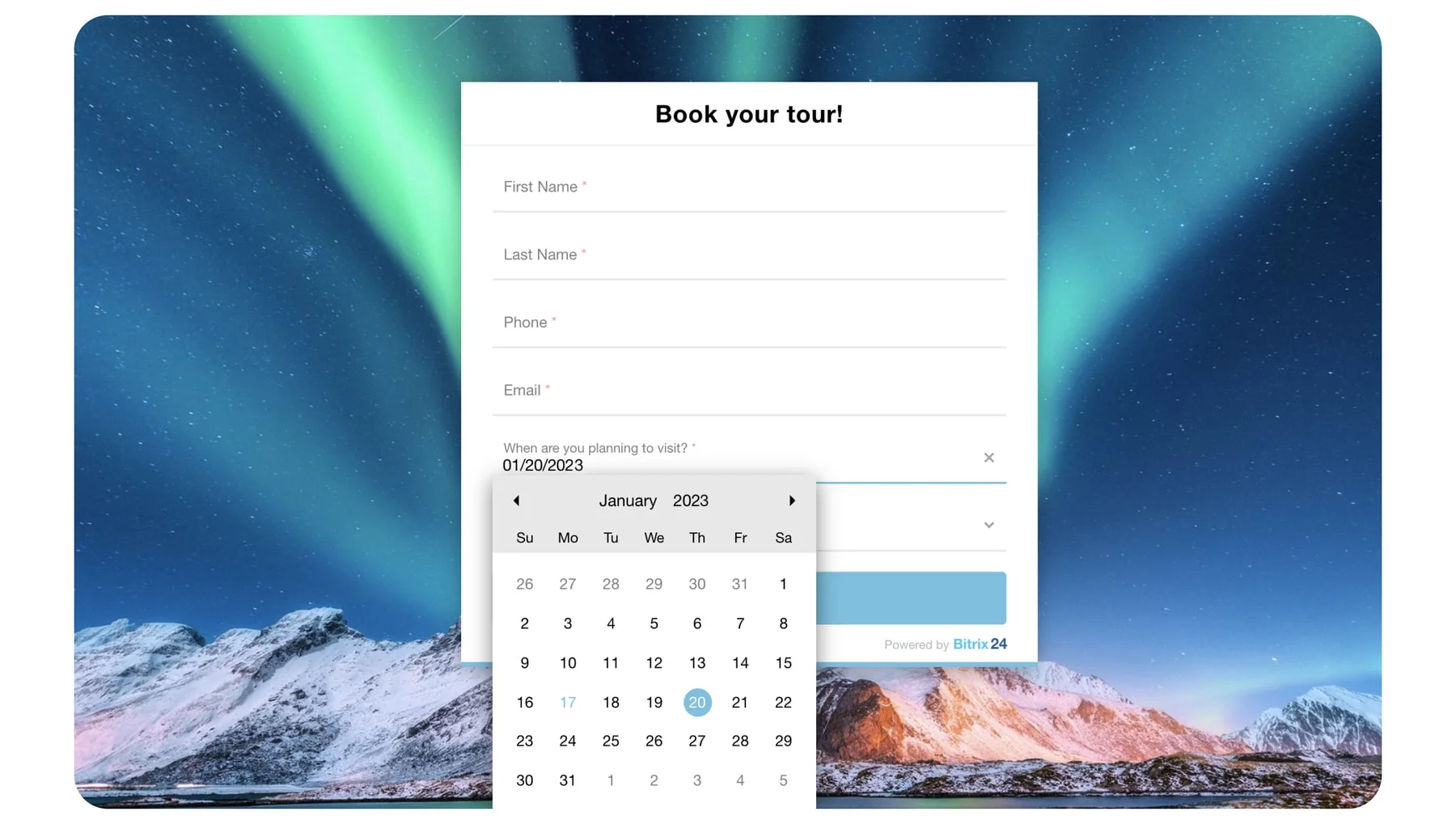
Omnichannel Contact Center in Bitrix24 · © Bitrix24
On its Contact Center page Bitrix24 lists CRM web forms, live chat with bots and AI, social network integration, built-in telephony with a free virtual phone number, IVR, call queueing and routing, call recording, HD video conferencing, an email server and a mobile app. It notes that queueing and routing lets smaller businesses handle calls with fewer employees.
Translate that into a laundry: the "is my order ready?" call is answered by whoever is free, against a record that shows the order stage; the hotel housekeeper's WhatsApp message asking for an extra collection lands on the account rather than on a supervisor's personal phone; and the recorded call settles the argument about what was promised. When a driver or a coordinator leaves, the history stays with the account.
Estimates, invoices and payment links belong on the record
Bitrix24 lists estimates, invoices, payments, product catalog, e-signature and inventory management among its CRM tools, and includes online payments, invoices and estimates, a web form designer and e-signature in its published plan features. For a laundry the catalogue is the price list — shirt, thobe, abaya, three-piece suit, duvet, curtain drop, uniform set — priced per piece or per kilo, with services sitting alongside products.
A contract quote is then built from catalogue lines rather than retyped into Word, the signed agreement is attached to the account, and the month-end invoice is raised from the same record that holds every collection in the period. Online payments mean a retail customer can settle a link before collection instead of arguing at the counter.
Automation is where the hours actually come back
This is the section that pays for the project. Bitrix24 describes setting up automated client notifications via SMS or email, customisable triggers that automatically move leads and deals down the pipeline, and automated notifications to your own staff based on lead or deal status.
A laundry has an unusually clean set of trigger points. Order moves to ready → customer gets an SMS. Order sits at ready for four days → the account owner gets a nudge about uncollected items. Contract deal reaches delivered → the invoice goes out. Collection day arrives for a hotel account → a task lands on the driver. None of those need a person to remember them, and each one is a place where a busy operator currently loses either money or a customer.
CoPilot, and the phone in the driver's pocket
Bitrix24 includes a free AI assistant, CoPilot, which Bitrix24 says can create marketing copy, generate ideas, and transcribe phone calls in the CRM — autocompleting the fields in the relevant lead or deal — with an AI scoring tool for sales forecasting. For an operation where most orders still arrive by phone, a transcript attached to the record is a genuinely useful artefact: it is the piece count, the special instruction and the promised date, written down without anyone writing it down.
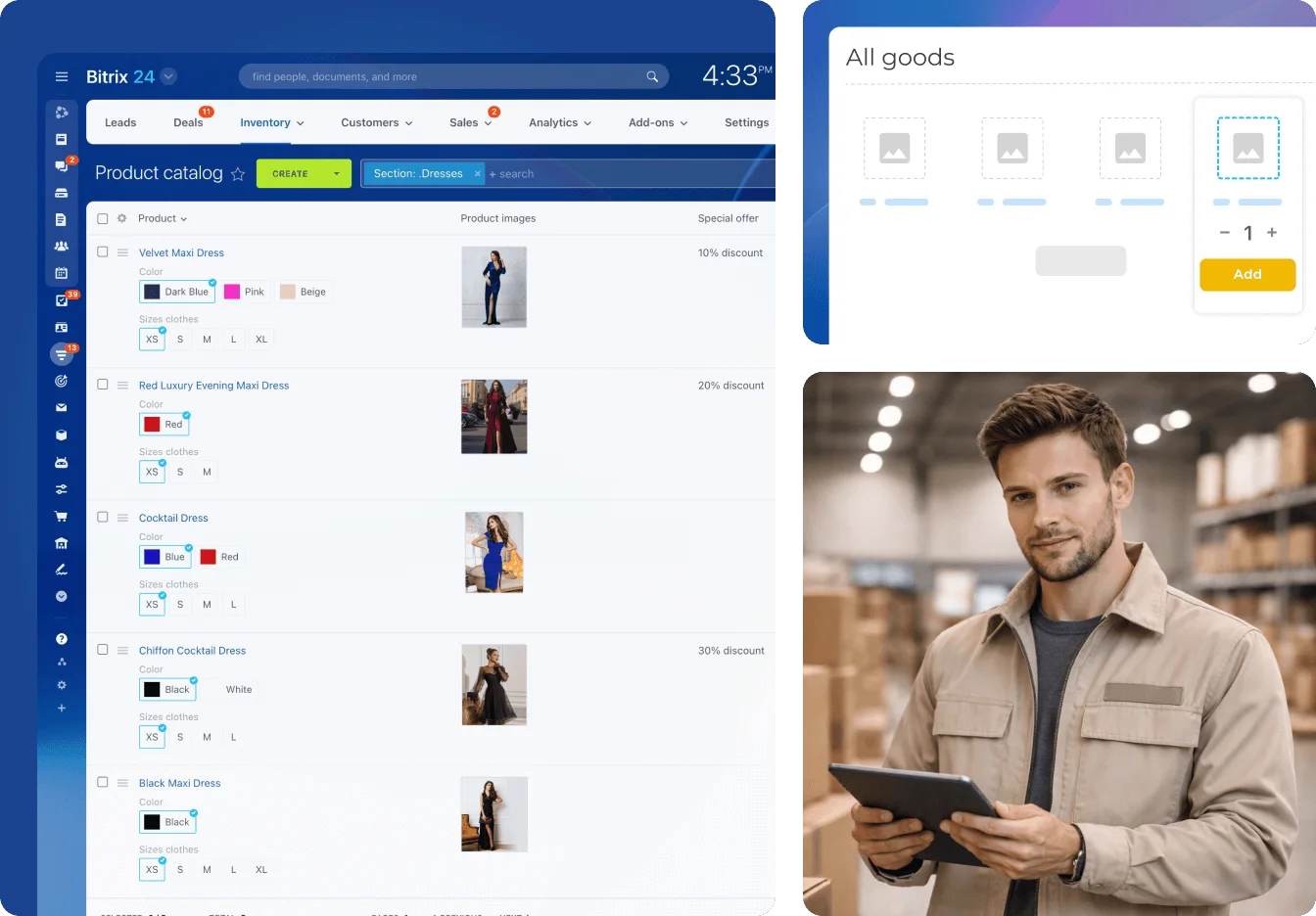
Bitrix24 in multi-location retail operations · © Bitrix24
Bitrix24 also lists a mobile sales app, work time tracking, tasks, file storage, calendar and online documents alongside the CRM, and its retail materials describe supporting multi-location businesses with streamlined inventory control and targeted campaigns across social media, email and SMS. A driver working from the mobile app can close a collection, a branch supervisor can see their own site's board, and a marketing push to dormant retail customers runs from the same customer list rather than an exported CSV.
What it costs
Bitrix24 publishes its plans openly, and as of this writing the pricing page shows the Vibe+ tiers with an annual discount under a launch offer Bitrix24 states runs from 1 September to 10 December 2026 for 12-month subscriptions. Basic Vibe+ is listed at US$ 89 per organisation per month, or US$ 59 billed annually, including 5 users, with sales pipelines, recurring deals, online payments and WhatsApp and telephony integration. Standard Vibe+ is US$ 199, or US$ 120 billed annually, including 50 users, adding invoices and estimates, e-signature, a web form designer and WhatsApp marketing. Professional Vibe+ is US$ 399, or US$ 240 billed annually, including 100 users, adding sales automation, booking, task automation, employee hours tracking and analytics. Enterprise Vibe+ starts at US$ 799, or US$ 480 billed annually, including 250 users.
Note the shape of that pricing: it is flat per organisation with a user count included, not per seat. For a laundry with a large floor team and a small office team, that difference is material — and it means the honest question is which tier carries the features you need, not how many people you can afford to licence.
What Bitrix24 does not do for laundries
Worth being straight about. Bitrix24 publishes no dedicated laundry or dry cleaning industry module. There is no built-in garment tagging or barcode-per-piece tracking designed for textiles, no route planning for collection vans, no weighing-scale integration, and no plant-floor machine scheduling. The CRM will hold the account, the order, the price list, the invoice and the conversation — the physical tracking of an individual garment through a plant is something you either design on top of custom fields and a workflow, or source separately. Bitrix24 points to its Market, which it describes as holding 550+ apps and solutions, and to its REST API for anything beyond that.
It is also worth saying that automation only helps if the underlying process is decided. A trigger that sends an SMS at ready is useless if three people disagree about what "ready" means.
Where a partner comes in
Everything above is standard Bitrix24. What is not standard is your business: how many branches, whether contract accounts are billed per piece or per kilo or per month, which stages a garment genuinely passes through, who is allowed to discount, what a driver may see, and how a disputed piece count gets resolved. Those decisions are the configuration — and they decide whether the system is still in use in week four or quietly abandoned for the docket book.
That is the work: mapping the two pipelines to how orders actually move, building the price list as a catalogue, wiring the notification and invoicing triggers, setting permissions per branch, and training the counter staff and drivers who have to live in it every single day.
Sources
- Bitrix24 — CRM: leads, deals, pipelines, automation triggers, CoPilot AI, omnichannel Contact Center, estimates, invoices, payments, product catalog, e-signature, inventory management, mobile app, Bitrix24 Market
- Bitrix24 — Contact Center: CRM web forms, live chat, social networks, built-in telephony and virtual number, IVR, queueing and routing, call recording, video conferencing, email, mobile app
- Bitrix24 — Plans and pricing: Vibe+ tiers, included users, storage and feature lists, launch offer terms
- Bitrix24 — Retail: multi-location operations, inventory control, marketing campaigns across social media, email and SMS
Running a laundry, dry cleaning or uniform services business?
We help laundries, dry cleaners and uniform service providers across the UAE, Middle East and South Asia set up Bitrix24 contract and operations pipelines, price lists built as a catalogue, one inbox for WhatsApp and phone orders, automated ready-and-collection notifications, month-end invoicing with payment links and per-branch permissions — configured around how your plant actually runs.
Book a free consultation →